Follow us:

Have you ever asked your child to repeat the Arabic letters, only to realize that they forgot most of them after just a few minutes?
Yet at the same time, your child might memorize an entire story with all its details and repeat it to you days later!
The problem here is not the child’s ability to learn, but the way the letters are presented. A child does not learn through rote memorization, but learns when information is connected to an experience, an image, and a story.
This is where the real difference appears between traditional methods and modern How To Teach The Arabic Letters approaches that rely on interaction and imagination, such as alphabet stories.
In this article, we will provide you with a practical method that helps you understand How To Teach The Arabic Letters to your child easily, with clear steps you can apply immediately.
Many children find it difficult to learn Arabic letters, not because the letters are difficult, but because the methods used often rely on:
When a child sees the letter “ب” alone, without a story, image, or situation, they have nothing to connect it to.
But when the letter is linked to a story such as: “A duck playing in the lake,” the child begins to connect the letter with the image, sound, and meaning.
If you are looking for effective ways to understand How To Teach The Arabic Letters, there is a simple rule: the more interactive and imagination-based the method is, the faster and more stable the learning becomes.
Here are the most important practical methods:
Stories are one of the most powerful tools for teaching children because they:
That is why alphabet stories are among the most effective methods for How To Teach The Arabic Letters.
Images help children:
Not just repetition, but repetition through:
It is important for the child to hear the letter and use it, not just see it.
However, despite the importance of these methods, the real challenge remains: how can you combine all these elements into one easy-to-apply experience?
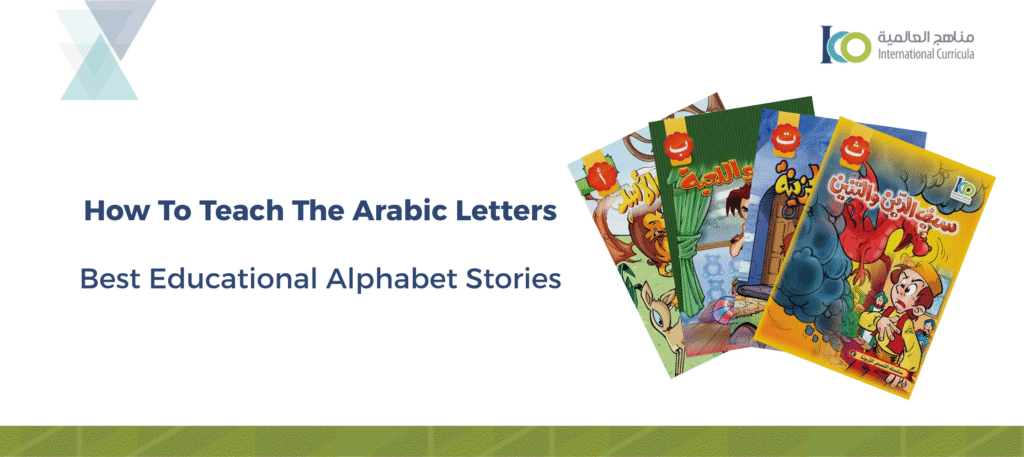
Alphabet stories are one of the most effective approaches when learning How To Teach The Arabic Letters, because they combine:
When a child reads a story about a specific letter, they do not just learn the letter, but they also:
This is what makes How To Teach The Arabic Letters easier when using stories compared to any other method.
If you want to apply this method, here are simple steps you can start today:
Start with one letter at a time, and choose a short story related to it.
For example:
Do not just read to your child, but:
Here are some stories suitable for reading with your child:
After the story, ask your child:
Here are some stories suitable for this step:
Turn learning into a game:
Here are some stories suitable for this activity:
Set aside 10–15 minutes daily to read a story for a new letter.
In this way, How To Teach Arabic Letters becomes an enjoyable experience instead of a boring task.
Here are our suggested stories for your child:
Even when applying How To Teach The Arabic Letters, there are some mistakes that can reduce learning effectiveness:
That is why purchasing Alphabet Stories helps you avoid these mistakes easily. You can get them now from our store at an affordable price.
Because they provide a complete learning experience where:
This makes them one of the strongest tools for How To Teach The Arabic Letters in modern education. Get them now from our store and help your child learn the Arabic alphabet easily.
If you are looking for a simple and effective way to understand How To Teach The Arabic Letters, alphabet stories from Manaahej offer you a ready-made solution.
These stories are designed to combine:
What makes these stories unique is that they do not just present letters, but also help the child to:
They can also be used in:
This makes them a practical, not just theoretical, solution.
Get them now from our store and help your child learn the Arabic Alphabet easily.
If you want your child to enjoy How To Teach The Arabic Letters, start with these steps:
You will notice that your child begins interacting with Arabic letters naturally, without pressure.
You can start teaching letters at an early age, but what matters most is the method.
When you apply the right approach for How To Teach The Arabic Letters, such as using stories, learning becomes:
That is why we offer a collection of Alphabet Stories through our store to help you teach your child in a fun way.
With the evolution of education, teaching letters no longer depends on memorization, but on:
That is why Alphabet Stories have become an essential part of modern educational programs, as they balance:
Finally, teaching letters is not just the first step in learning, but the foundation upon which all language skills are built.
When applying the right approach for How To Teach The Arabic Letters, such as using stories, the child does not just memorize letters, but understands and uses them.
That is why Alphabet Stories from Manaahej are a practical solution that combines learning and fun, helping children build a strong language foundation in a simple and engaging way.If you are looking for the best way for How To Teach The Arabic Letters, you can now explore the collection of alphabet stories available in the Manaahej store and choose what suits your child’s age to begin an enjoyable learning journey from the very first letter.
Please send us an email at info@manaahej.com
WhatsApp +966500479845

One of the world’s leading and specialized organization in producing Arabic and Islamic curricula and other related books.