Follow us:

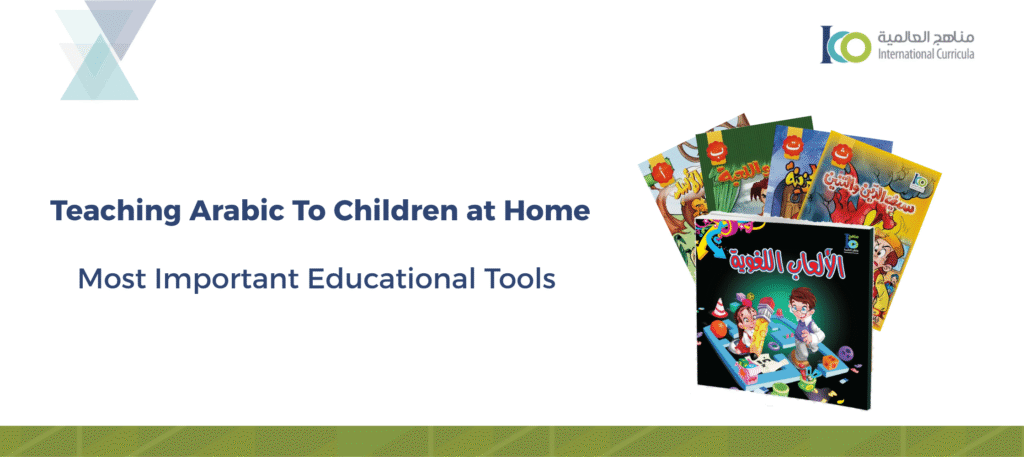
Learning a language does not necessarily mean acquiring it! This is exactly the point where most attempts at Teaching Arabic To Children at home fail.
When trying to apply a method for Teaching Arabic To Children at home, most parents start from an assumption that seems logical at first glance:
If a suitable book is provided, words are explained clearly, and exercises are repeated, the child will gradually acquire the language.
However, the educational reality reveals a clear gap between this assumption and the actual results.
A child may be exposed to a good amount of vocabulary and may recognize some structures, yet their ability to use the language in a real context remains limited.
Here, the core issue that hinders the success of Teaching Arabic To Children at home appears: the confusion between learning a language and acquiring a language.
Learning refers to understanding rules and vocabulary theoretically, while acquisition means the ability to use the language automatically in real-life situations.
Most traditional methods of Teaching Arabic To Children tend toward the first pattern, which leads to limited results in terms of actual usage.
To understand how to improve Teaching Arabic To Children, it is necessary to analyze the nature of the home environment as a learning space.
Unlike the classroom, the home environment does not typically have:
As a result, teaching often relies on individual effort, which leads to:
Language teaching principles indicate that acquisition depends on three main elements:
When these elements are absent, learning becomes a process of memorization only.
Thus, Teaching Arabic To Children can be redefined as:
“A gradual process of building the child’s ability to use the language through exposure, interaction, and production.”
To effectively apply Teaching Arabic To Children, theoretical principles must be translated into clear, actionable steps using appropriate educational tools.
This is where choosing the right type of content becomes essential, whether a structured curriculum, educational stories, or language games, because each serves a different aspect of language acquisition.
Below are the most important steps for Teaching Arabic To Children at home:
Language acquisition depends on understanding words within context, not memorizing them in isolation.
This is where children’s stories become important, as they present vocabulary within events and situations.
For example, instead of teaching the word “water” directly, the child can read a story containing sentences such as:
“The boy drank water” or “Bring me water.”
In this way:
That is why stories are among the most effective tools in Teaching Arabic To Children, as they turn vocabulary into experience. You can now get the best educational stories for children from Manahej and use them as a practical tool to teach your child Arabic in the right way.
After the child becomes familiar with vocabulary through stories or lessons, they must begin using it in daily life. However, many books fail to support this transition.
This is where activities and language games play a key role, as they:
For example, activities from a language games book can be used to ask questions such as:
In this way, learning moves beyond the book into practical daily use. You can now get the language games book from Manahej to transform learning into daily interaction your child enjoys.
Speaking requires a supportive environment, and this is where a structured curriculum becomes essential, as it provides:
When a child follows a clear sequence within an Arabic curriculum, speaking becomes a natural part of learning rather than a delayed step.
Relying on a structured curriculum helps in:
Repetition becomes effective when used across different contexts. This is where integration between tools becomes important:
For example, the child learns the word “book” in a lesson, then sees it in a story, and then uses it in a game or question.
This varied repetition is what reinforces learning.
One of the main reasons Teaching Arabic To Children fails is randomness.
A child learns one day, stops for several days, uses one book, then switches to another this does not build real skills.
That is why having a complete curriculum, such as the Arabic curriculum from Manahej, helps to:
When combined with educational stories and language games, learning becomes a complete system that helps your child learn Arabic more easily and effectively.
In this context, the Arabic curriculum from Manahej plays a key role as a practical tool for turning these principles into effective application.
This curriculum builds a learning path based on:
This makes it suitable for Teaching Arabic To Children at home without requiring advanced teaching experience.
When used alongside story collections and the language games book, you create a complete learning environment at home.
How do these educational tools support parents?
These educational tools from Manahej provide you with:
This makes Teaching Arabic To Children easier and more organized.
When applying the correct method using a structured curriculum, reading educational stories, and engaging through a language games book, the child moves from recognizing words to using them, from understanding to expressing, and from hesitation to confidence.
This is the true goal of Teaching Arabic To Children.
Ultimately, the success of Teaching Arabic To Children at home depends on how it is implemented within a clear methodological framework.
When combining:
The child does not learn the language as information, but acquires it as a skill.That is why using the Arabic curriculum from Manahej is a practical choice that helps parents apply learning in an organized way and gives the child a real opportunity to use the language with confidence.