Follow us:

How can your child memorize 20 words in one hour… and then fail to use even two of them in a sentence?
This is not a memory problem. It is a learning method problem.
In most Arabic lessons, what children receive is:
That’s why, no matter how much progress they make in learning to read and write Arabic, there is always a clear gap between what they know and what they can actually say.
But when learning becomes an interactive experience through Language Games, everything changes. Your child starts: Using words instead of storing them, Building sentences instead of repeating them, Thinking in the language instead of memorizing it.
In this article, we will provide a practical framework showing how Language games can be used to develop vocabulary, improve expression, and support Arabic learning for children in a way that produces real, noticeable results.
The problem lies in how most Arabic lessons are structured:
Explain → Memorize → Test
This model focuses on:
recalling information not using it
As a result, the child treats language as a school task rather than a real-life tool.
For example:
A child may learn the word “beautiful”, understand its meaning, and repeat it. But do they use it to describe something they see? Usually not.
Why?
Because they were never trained to use it in context.
Any method of teaching Arabic to children that does not connect: the word, its use and its context, will lead to the same result: superficial learning with no real impact.
In Language Games, the child does not receive the word directly. They reach it through an activity and use it within a situation.
This activates multiple skills at once:
When children engage in this type of learning activity:
This is where language shifts from: something memorized to something used
Using Language games requires a clear structure to ensure real results.
Before starting any activity, ask yourself: What do I want the child to gain?
Is it:
When the goal is clear, choosing the right Language Games becomes easier, and the activity turns into a powerful learning tool instead of random play.
One of the most important differences between surface and deep learning is: using the language, not just recognizing it.
Recognition means choosing the correct answer. Usage means the child:
This is the core of real learning.
Always ask: Does this activity force the child to use the language?
If the answer is no, then it is a weak activity, no matter how fun it seems.
A word without context is quickly forgotten. A word within context is remembered.
For example:
Instead of teaching the word “apple” alone, teach it within a sentence, situation, or description.
This is what makes Arabic learning for children effective, because the child starts to see language as part of life, not just a subject.
One common mistake is trying to teach too many words at once.
But children need:
Teaching a small number of words and using them in multiple activities is far more effective than introducing many words without usage.
Repetition is important, but how you repeat matters. Instead of repeating the same activity:
This helps the child move gradually from recognition to usage, which directly supports reading and writing skills in Arabic.
Despite understanding the importance of Language Games, practical implementation often fails due to:
This leads to temporary fun without real learning outcomes
The difference between effective learning and random effort is: structure
Instead of thinking of new activities every day, experimenting and guessing, you need:
This is what makes Language Games a real tool, not just an idea.
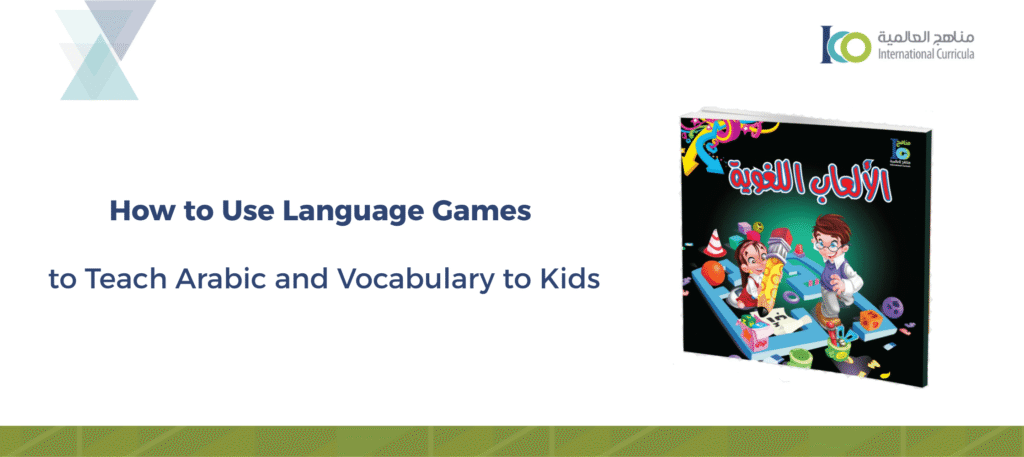
If you are looking for a way to apply Language games correctly, the Language Games Book by Manahej provides a ready-made system.
The book includes many Language games, saving you time and effort while offering multiple options for different learning situations.
The activities are not random. They are designed to develop key skills such as:
These are the core foundations of language development.
The book is specifically designed for children in the early stages, making it highly effective for building vocabulary and foundational skills.
Each activity is engaging while still serving a clear educational purpose. This completely changes the child’s perception of learning.
No complex preparation is required. It can be used directly at home or in the classroom.
You can now get the Language Games Book from Manahej’s store.
When Language games are used in a structured way, the results become clear over time.
You will notice that the child:
This is the true goal of learning Arabic.
To ensure effectiveness, avoid these common mistakes:
These mistakes may make the experience enjoyable, but they do not produce real learning results.
Success does not appear in memorization, but in usage. If the child:
Then learning has become real, not temporary.
Language is not built through memorization, but through usage.
That is why Language games are not an optional method, but a core part of effective learning.
When applied correctly, they transform learning from: something memorized into something used
With ready tools like the Language Games Book by Manahej, you can easily apply this method and achieve clear results.
If you want your child to learn Arabic without boredom, start using Language games but use them the right way.You can now get the Language Games Book from Manahej’s store.
Please send us an email at info@manaahej.com
WhatsApp +966500479845

One of the world’s leading and specialized organization in producing Arabic and Islamic curricula and other related books.